Posts

Showing posts with the label ice climbing

Why I climb Free Solo
Image
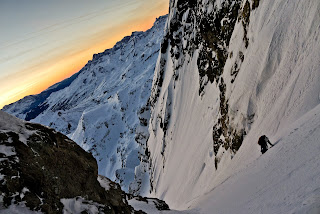
  As an individual, I like my own company above all and spend weeks, months at a stretch away from all human in high mountains and forests. I often climb big mountains solo, with very little on my back. I also free solo ice lines, frozen waterfalls, far from any human presence. And I am often asked why do I do it, since it is also very risky, dangerous and generally not done by many. Many free solo climbers do it once in a while. I do it more often.   Right from my childhood, from the time I took to the mountains, I was an introvert and just loved the majestic sky kissing icy peaks and the sprawling glaciers all to myself. The gaping crevasses didn’t scare me, rather drew me into their icy depths and the lofty summits ignited deep within an unquenchable thirst for those forlorn places. Places where no man has ever been before, or very few before me. I started climbing with people much elder to me in age and experience and I was fortunate to learn from some of the world’s l...

My Frozen Love Affair

I love frozen water; soft or hard, not too soft though. I have been in love with frozen water almost all my life. The love affair started when I was ten and stepped on my first Himalayan glacier; love at first sight. As my tiny foot crunched ice beneath my boots, a thunderbolt passed through my body and brain, defining the path that I would follow for the rest of my life; which has now taken me around the world in search of ice and snow in its myriad forms. From the highest summits to the deepest oceans, to the poles and to the tropics, from volcano craters to ice caps I have pursued frozen water in all its shapes, sizes, forms, dimensions, colours wherever they may be. Charting my life through hundreds of far flung freezing glaciers, skipping across lofty summits piercing the azure, ice fields and Polar Regions I have realized that ice and snow is something that I just cannot have enough of, just like love. I have a restless explorer’s heart and a curious mind and the dynami...

Don't Talk Just Climb

Image
I am motionless as a spider spying upon its prey. I am stuck on a sheer column of ice, no thicker than few inches with visible ground far beyond my eyes dare to travel. I feel like a spider but wonder (the most irrelevant notion at that moment) if ever a spider has ventured across icy terrains of such smoothness and vertical travesty. Even as my eyes, though still, look for places where I could place my ice pick, my four limbs glued to the element begins to grow weary. Precious seconds are ticking away and all I can do is gasp, breathe, and pray for a miracle. With mother Earth nearly 100 m below I am venturing upon a new ice route in the cold frigid mountains of Colorado’s Telluride town deep end of box canyon on one of the most treacherous and iconic winter routes of all, the dreaded ‘Bridal Veil’ graded WI 5-6 under normal conditions. It is a tottering column of such jumbled ice sculpture that from the bottom you cannot see even 1/4 th of the way up.

Life on the Edge – Night without End

As another scoop of powder avalanche fell on top of my chest, compressing the tiny tent roof into my ribs further, I knew it was time again to hop out and shovel away the continuous debris of ice and snow that was falling from the top, burying us slowly but surely within our tent. Anyone who has ever used a Helsport Ringstind Superlight would know that this tent doesn’t come with elbow room. It’s the ultimate all thrills tent without a single frill. I nudged my partner in the rib, who remained listless as ever, looking in a daze at the roof of the tent. In the ghostly pallor of my headlamp he looks more dead than alive. I wriggle my wrist out of the sleeping bag and immediately recoil at the dense cold that claw at my innards and skin like a starving griffin. My right hipbone is pushing into the tent wall and I know fully well that beyond and right outside the thin tent fabric lies a 3000 ft void that simply drops down into a smooth wall of ice. But for the tent, my right side outer ...

One More Step

I am often asked what exactly my mind churns when I am doing a dangerous and reckless climb, where the outcome is unknown and I had already crossed the point of no return. Never have I been able to give a satisfactory answer, mostly I would nod and say I don’t remember, since once out of the perilous situation (self orchestrated) my numb and dumb brain would quickly forget all that my mind must have gone through. But in a recent trip of mine, the moment I returned to safer grounds, I jotted down some of my thoughts immediately on a piece of paper and later on reading it, thought it may still not be the right answer to the question of my mind, but it is a convincing one nevertheless, so here it is. While I was going through the miniscule notebook that I had managed to keep and return with during this trip, through the smudged up pencil marks and torn and soaked pages, I discovered that at the end of the day when I climbed the peak and then came down through atrocious conditions, thankfu...

When I discovered a new style of climbing

Image
In the beginning of the great Himalayan climbs there was the ‘siege ‘ style that was more like a jamboree headed by a sahib of British or European origin, followed by a staggering number of porters, orderlies, factotums, carrying even more staggering number and volume of scientific and exploratory equipment. They were mostly unsure of what they intended or what the specific objective of it all was; if there was one. The idea of actually standing astride a lofty summit was primarily secondary since exploration and opening up the area and filling up the blank spaces in the maps were more in the order of the day. Few intrepid climbs were done nevertheless by such swashbuckling leaders like Shipton, Smyth et al. With the end of the European exploration and British dominance of the Himalaya post Indian independence, the next few decade unfurled the siege style to its utmost glory and evolutionary developments till one day two fine men from the Alps came and introduced ‘Alpine’ style into th...

No lingo, no problemo – Snowy days in Scotland

Image
In climbing, especially the extreme kind where we dangle from non-existent holds and bullet-proof vertical ice slabs, words and languages are mostly superfluous. We often don't say anything, in order to save our breaths and energy for that one impossible move, and when and if we do, it is often an expletive to which we don’t expect an answer. For our last prayers, when the need arise for such devotion to God, we generally mutter silently inside the deepest and unknown recesses of our souls asking forgiveness for our stupidity. In none of the situations, as you can evince, are words or languages (that can be understood by your climbing co-conspirators) necessary. Climbing is an activity that transcends borders of demography, religion, sex, language and visions. Where we perhaps differ, fundamentally, is our individual ethics and reason to climb. Put any two climbers together on a hard route, who may have never met before, or don't understand each other's tongue, and they wou...

My Top Ten Climbs in South America Andes

Image
For me a mention of South America always conjures up visions of some of the finest mountains and glaciers in the world. It is my single most favorite continent on Earth and if not an Indian I would have definitely wished to be a South American; a Peruvian or an Argentinean to be more specific. The largest and most voluminous natural feature of South America is certainly the Andes range of mountains. The Andes run almost the entire length of the continent’s western edge starting from Venezuela to Chile and Argentina passing through Columbia, Ecuador, Bolivia and Peru. It is nearly 7500 km long and averaging around 250 km at its widest. Towards the south it is often referred as the Patagonia sub-range. During my several journeys to the continent I have covered quite a bit of this massive mountain range, which is home to some of the finest and most technical mountains on Earth. Topographically the longest mountain range in the world can be divided into Northern, Central and Southern parts...